Saturday, November 8, 2008
In Focus Haiti: House Call in Hell by Antigone Barton
In Focus Haiti: House Call in Hell
Learn more about this video at: http://pulitzercenter.org/showproject.cfm?id=51 This video takes you inside the walls of one of the worst prisons in the Western hemisphere. Overcrowding, poor sanitation, and a general lack of funding in Haiti's National Penitentiary have led to exorbitant HIV and Tuberculosis rates. Reporter Antigone Barton and videographer Stephen Sapienza take a first-hand look at these conditions and an American doctor working to correct them. After this video was taken, USAID authorized $200,000 in emergency funding for health and sanitation improvements. Visit the interactive narrative at: www.palmbeachpost.com/heroes
Haiti's Separate Worlds for Rich and Poor (Al Jazeera)
Haiti's Separate Worlds for Rich and Poor - 19 Oct 08 -
Haiti may be one of the poorest countries in the world, but it's also home to some very wealthy communities. It's a situation that's creating a significant divide between the haves and the have-nots. Al Jazeera's Teresa Bo reports from the capital Port au Prince on the huge disparity between rich and poor.
NOTE: Man identified in video as Harry Desire is actually Harry's brother, Harres Désiré.
Friday, November 7, 2008

Thursday, November 6, 2008
Haiti Hope
Haitian Hope - Free videos are just a click away

BZ Films (http://www.bzfilms.com) is proud to have produced Haitian Hope, a short film bringing to light the issues in Haiti brought on by four storms that devastated the small country. The film was produced in conjunction with Partners In Health, an organization with the simple goal to do whatever it takes. Partners in Health is a worldwide organization dedicated to bringing health care to those who need it. For BZ, creating this film was moving and heart breaking. The goal was to bring awareness. BZ encourages you to watch, share and support Partners In Health.
Pregnant women desperate for free emergency care in Haiti
 Haiti 2007 © Julie Rémy
A patient waits for an available bed five hours after being admitted to the hospital.
DOCTORS WITHOUT BORDERS
Press Release
November 6, 2008
Pregnant Women Desperate for Free Emergency Care in Haiti
Doctors Without Borders Struggling to Provide Care
Port-au-Prince, November 6, 2008 – Teams from the international medical humanitarian organization Doctors Without Borders/Médecins Sans Frontières’ (MSF) are struggling to provide free, quality emergency care to pregnant women and their babies in Port-au-Prince, the capital of Haiti.
Over the last month, hundreds of women have desperately sought emergency obstetric care at Jude-Anne hospital in Port-au-Prince. In October, hospital staff assisted a record high of 56 women giving birth in one day and received 160 women waiting for hospitalization. The hospital has been so overwhelmed by demand that mothers have given birth in the hospital’s waiting room, the staircases, and in the washrooms, essentially anywhere they could find space.
Read rest of press release at http://www.doctorswithoutborders.org/pr/release.cfm?id=3172
Thursday, October 30, 2008

Monday, October 20, 2008
In the Aftermath of Hurricanes, Haiti Situation is Critical

In the Aftermath of Hurricanes,
Haiti Situation is Critical
Mark Schneider 20 Oct 2008
World Politics Review Exclusive
A decade ago, when Hurricane Mitch devastated Central America, the world reacted with immediate, nearly unlimited generosity. Two weeks after that disaster, the U.S. already had pledged $263 million. Soon thereafter, Sweden hosted an international pledging conference that produced pledges of $9 billion to rebuild smarter and better.
A decade ago, when Hurricane Mitch devastated Central America, the world reacted with immediate, nearly unlimited generosity. Two weeks after that disaster, the U.S. already had pledged $263 million. Soon thereafter, Sweden hosted an international pledging conference that produced pledges of $9 billion to rebuild smarter and better.
By contrast, in barely three weeks beginning in mid-August, four hurricanes -- Fay, Gustav, Hannah and Ike -- lashed Haiti and the Caribbean, and the international response has been eerily muted. In Haiti, roads are still blocked, bridges are down, and the country's agricultural heartland is flooded. More than 800 were killed, 100,000 people are displaced and another 130,000 families suffered serious damage to their farms and homes. Local businesses are crippled. Food distribution to rural communities is critical but is nearly impossible because of the continuing mudslides. In hard-to-reach areas, there is a real danger of famine.
Despite the devastation, the U.S. has committed just $30 million for Haiti. The U.N. has sent out a humanitarian appeal for $107 million, but only $20 million has been received. In fact, the most significant pledges came from private philanthropies at the Clinton Global Initiative annual meeting in New York last month. A number of private individuals and relief agencies are already struggling mightily with the challenges, but they are overwhelmed and under-supported.
The risk goes beyond humanitarian concerns. Haiti is so fragile today that it requires a U.N. peacekeeping force (MINUSTAH) to keep it afloat. Recall that food riots resulted in several deaths and occupation of public buildings in February and forced one Haitian government out of office. Political unrest and violence loom if there is not a rapid and extensive response to this natural disaster.
Not only was the economic infrastructure destroyed by the hurricanes, but public services were hard-hit as well. Police cars in Gonaives were swept away. In other cities and towns, courthouses were flooded. Without these basic tools in place, ongoing efforts to reform the security sector by vetting police, establishing standards for judges and responding to overcrowded jails will grind to a halt.
With school starting, many children will not be able to attend classes because dozens of school buildings are still being used as shelters, while others were simply washed away. Most families will be unable to pay school costs in a country where free public education exists for barely 20 percent of school-age children. Donors need to construct an urgent safety net by helping those families pay to enable the children to attend school.
A vast rebuilding and transformation is needed in virtually every sector. The same kind of comprehensive donors meeting that was held in Stockholm a decade ago should be organized by the international community to provide Haiti, which is far more desperate today than Central America was a decade ago, with a 10-year multibillion dollar pledge of recovery and reconstruction. That conference should also address the needs of other Caribbean countries harmed by the hurricanes, including Cuba.
Another immediate step that the Bush Administration should take is to order Temporary Protective Status for Haitians, which would ensure that current illegal migrants would not for now be forced back into an already overburdened Haiti.
If Haitian families cannot send their children to school, if their farms cannot produce, if roads and bridges are not repaired, and if electricity and clean water remain scarce, even the U.N. peacekeeping force may find it difficult to control the next riot.
Mark L. Schneider is the senior vice president of the International Crisis Group.
Photo: Members of the Jordanian battalion of the United Nations StabilizationMission in Haiti (MINUSTAH) rescue children from an orphanage destroyedby hurricane "Ike," Port au Prince, September 2008 (UN photo by Marco Dormino).
Hitting a Wall on Immigration by Bishop Thomas Wenski

(Photo and caption borrowed from The Florida Catholic and are not connected with article below)
Bishop Thomas G. Wenski meets with Haiti's President Rene Preval July 16 at the presidential palace in Port-au-Prince. Bishop Wenski, who was in Haiti recently, said the country needs political stability to combat its extreme unemployment and poverty. Photo Father Andrew Small,OMI
===============================
The Washington Post
Hitting a Wall on Immigration
By Thomas Wenski
Monday, October 20, 2008; A15
As the presidential election heads into its final days, the issue of immigration remains largely unaddressed. It was not examined during the debates and is not high on either candidate's list of talking points. Congress has left the issue on the table. Sadly, this congressional reluctance has created a policy vacuum that has widened America's political divisions and left us with an inconsistent, ineffective and, in many cases, inhumane national policy.
The failure of comprehensive immigration reform last year, when Congress bowed to a vocal minority, unleashed a torrent of initiatives designed to demonstrate that the U.S. government can enforce our laws and secure our borders. In truth, intermittent work site raids, increased local law enforcement involvement and the creation of a wall along parts of our southern border, among other efforts, have done little to address the challenges presented by illegal immigration.
The most visible of these initiatives has been the work site raids in cities and towns across the nation. While these enforcement actions meet the political need to show government's law enforcement capabilities, they have had minimal effect on the number of undocumented workers in the United States.
Instead, they have caused dislocation and disruption in immigrant communities and victimized permanent U.S. residents and citizens, including children. The sweeping nature of these raids -- sometimes involving hundreds of law enforcement personnel with weapons -- has made it difficult for those arrested to secure basic due-process legal rights, including access to counsel. Some families have been split up indefinitely.
The involvement of local law enforcement in immigration enforcement, most prominently in Arizona and parts of the South, has greatly harmed the trust between immigrant neighborhoods and law enforcement and has diverted police from the work of apprehending criminals. The border wall and an unprecedented immigration enforcement buildup along our southern border have failed to deter new entrants to the United States and have discouraged immigrants from leaving.
Perhaps most damaging are the adverse, long-term effects these policies have had on immigrant communities. The overriding emotion many immigrants feel is fear. Not only do legal immigrants worry that a loved one may be swept away in a work site raid or after a knock at the door at home, they are fearful for their own futures -- and the futures of their children -- in the United States. This is not the way to encourage integration and responsible citizenship.
While some organizations that oppose immigration are delighted by this and hope such an atmosphere will lead to a mass exodus of illegal and legal immigrants, they are likely to be disappointed. What they do not acknowledge is that 70 percent of the undocumented have lived in this country for five years or longer and have no home to return to. These people identify themselves more as Americans than anything else and would rather live here in the shadows than take their U.S.-citizen children back to a place they do not know.
Opponents like to argue that our economy does not need the work of immigrants, now or in the future. Again, they are wrong. The Labor Department predicts that in the years ahead, despite the current economic slowdown, a shortage of low-skilled labor will exist in several important industries, for some beginning as early as 2010. As baby boomers begin retiring, immigrants will help support them by paying billions into the Social Security system.
To many elected officials, immigration has become the new "third rail" of American politics. Refraining from addressing this pressing domestic issue, however, will elevate tensions in states and localities, further alienate immigrants and their communities, and tacitly affirm the acceptance of a hidden and permanent underclass in our country.
The silver lining of this dark cloud upon our immigrant history is that it demonstrates that an enforcement-only approach to illegal immigration is ineffective and contrary to our national interests. A new administration and new Congress will be forced to act -- this time in a broad and balanced manner. Otherwise, the American people will be left pondering a wall and wondering why it is not working.
The writer is the Catholic bishop of Orlando and a consultant to the U.S. Conference of Catholic Bishops' Committee on Migration.
Instead, they have caused dislocation and disruption in immigrant communities and victimized permanent U.S. residents and citizens, including children. The sweeping nature of these raids -- sometimes involving hundreds of law enforcement personnel with weapons -- has made it difficult for those arrested to secure basic due-process legal rights, including access to counsel. Some families have been split up indefinitely.
The involvement of local law enforcement in immigration enforcement, most prominently in Arizona and parts of the South, has greatly harmed the trust between immigrant neighborhoods and law enforcement and has diverted police from the work of apprehending criminals. The border wall and an unprecedented immigration enforcement buildup along our southern border have failed to deter new entrants to the United States and have discouraged immigrants from leaving.
Perhaps most damaging are the adverse, long-term effects these policies have had on immigrant communities. The overriding emotion many immigrants feel is fear. Not only do legal immigrants worry that a loved one may be swept away in a work site raid or after a knock at the door at home, they are fearful for their own futures -- and the futures of their children -- in the United States. This is not the way to encourage integration and responsible citizenship.
While some organizations that oppose immigration are delighted by this and hope such an atmosphere will lead to a mass exodus of illegal and legal immigrants, they are likely to be disappointed. What they do not acknowledge is that 70 percent of the undocumented have lived in this country for five years or longer and have no home to return to. These people identify themselves more as Americans than anything else and would rather live here in the shadows than take their U.S.-citizen children back to a place they do not know.
Opponents like to argue that our economy does not need the work of immigrants, now or in the future. Again, they are wrong. The Labor Department predicts that in the years ahead, despite the current economic slowdown, a shortage of low-skilled labor will exist in several important industries, for some beginning as early as 2010. As baby boomers begin retiring, immigrants will help support them by paying billions into the Social Security system.
To many elected officials, immigration has become the new "third rail" of American politics. Refraining from addressing this pressing domestic issue, however, will elevate tensions in states and localities, further alienate immigrants and their communities, and tacitly affirm the acceptance of a hidden and permanent underclass in our country.
The silver lining of this dark cloud upon our immigrant history is that it demonstrates that an enforcement-only approach to illegal immigration is ineffective and contrary to our national interests. A new administration and new Congress will be forced to act -- this time in a broad and balanced manner. Otherwise, the American people will be left pondering a wall and wondering why it is not working.
The writer is the Catholic bishop of Orlando and a consultant to the U.S. Conference of Catholic Bishops' Committee on Migration.
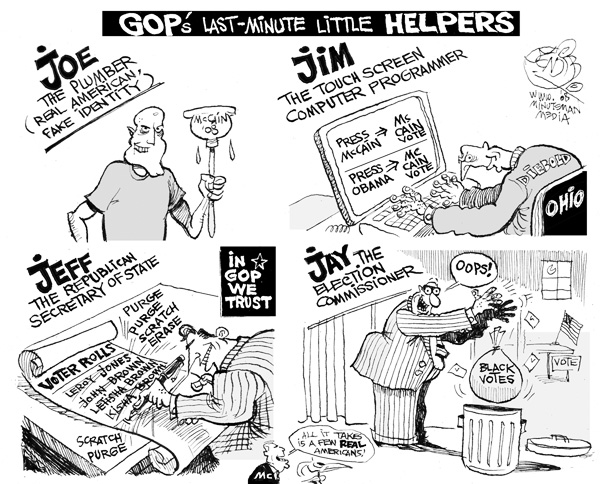
Block the Vote by Robert F. Kennedy, Jr. & Greg Palast
 http://www.stealbackyourvote.org/
Block the Vote
Will the GOP's campaign to deter new voters and discard Democratic ballots determine the next president?
By ROBERT F. KENNEDY JR. & GREG PALAST
"I don't think the Democrats get it. All these new rules and games … could flip the vote to the GOP in half a dozen states."
Rolling Stone Magazine is making this important investigative story available on the net in its entirety, free of charge.
Read this excerpt, then read it all on-line at www.RollingStone.com Or download it all, with the Kennedy-Palast voter guide, Steal Back Your Vote, at www.StealBackYourVote.org.
“The new registrations thrown out, the existing registrations scrubbed, the spoiled ballots, the provisional ballots that were never counted - and what you have is millions of voters, more than enough to swing the presidential election, quietly being detached from the electorate by subterfuge.
"Jim Crow was laid to rest, but his cousins were not," says Donna Brazile. "We got rid of poll taxes and literacy tests but now have a second generation of schemes to deny our citizens their franchise." Come November, the most crucial demographic may prove to be Americans who have been denied the right to vote. If Democrats are to win the 2008 election, they must not simply beat John McCain at the polls - they must beat him by a margin that exceeds the level of GOP vote tampering.
- From the current Rolling Stone
These days, the old west rail hub of Las Vegas, New Mexico, is little more than a dusty economic dead zone amid a boneyard of bare mesas. In national elections, the town overwhelmingly votes Democratic: More than 80 percent of all residents are Hispanic, and one in four lives below the poverty line. On February 5th, the day of the Super Tuesday caucus, a school-bus driver named Paul Maez arrived at his local polling station to cast his ballot. To his surprise, Maez found that his name had vanished from the list of registered voters, thanks to a statewide effort to deter fraudulent voting. For Maez, the shock was especially acute: He is the supervisor of elections in Las Vegas.
Maez was not alone in being denied his right to vote. On Super Tuesday, one in nine Democrats who tried to cast ballots in New Mexico found their names missing from the registration lists. The numbers were even higher in precincts like Las Vegas, where nearly 20 percent of the county's voters were absent from the rolls. With their status in limbo, the voters were forced to cast "provisional" ballots, which can be reviewed and discarded by election officials without explanation. On Super Tuesday, more than half of all provisional ballots cast were thrown out statewide.
This November, what happened to Maez will happen to hundreds of thousands of voters across the country. In state after state, Republican operatives - the party's elite commandos of bare-knuckle politics - are wielding new federal legislation to systematically disenfranchise Democrats. If this year's race is as close as the past two elections, the GOP's nationwide campaign could be large enough to determine the presidency in November. "I don't think the Democrats get it," says John Boyd, a voting-rights attorney in Albuquerque who has taken on the Republican Party for impeding access to the ballot. "All these new rules and games are turning voting into an obstacle course that could flip the vote to the GOP in half a dozen states."
Download the rest – and get the Kennedy-Palast comic book/voter guide – at http://www.stealbackyourvote.org/.
Or, read it on-line, and watch the video, at www.Rollingstone.com/issue1064
Friday, October 17, 2008
Experience vs. Inexperience
 Photographs by Associated Press
HONORS FROM THE CHAIRMAN Senator John McCain presenting Freedom Awards from the International Republican Institute to Vice President Dick Cheney in 2001; Condoleezza Rice, now the secretary of state, in 2004; and President Bush in 2005.
(photo and caption not connected to below email and is borrowed from New York Times article entitled Democracy Group Gives Donors Access to McCain)
received in email today. good piece on McCain's role in undermining democracies and plotting coups!:
October 17, 2008
Experience vs. Inexperience
by Ray Torres
Dear Voter,
My knowledge of John McCain foreign policy experience is disturbing. In the 1980s he served on the advisory board to the U.S. chapter of the U.S. Council for World Freedom. They worked with the CIA to fund the Contra war, who mission was to overthrow the democratically elected government of Nicaragua. In 1983 I was in Nicaragua with Witness for Peace and accompanied a bus load of widows from the Rio Coco farming cooperative whose husbands had been massacred by the Contras. We went to the U.S. embassy and dumped the American bullet casings at the gate of the Embassy. The Congress with pressure from Witness for Peace cut off funding to the Contras but the Council for World Freedom kept illegally funding the blood shed. This summer I returned with Witness for Peace to Nicaragua and meet with the Veterans of the Contra War, the former Contras who said that their American funders promised them land and money but the response from the Embassy, “We make a lot of promises that we don’t keep.”
In 1993, McCain became Chairman of the International Republican Institute (IRI) a post which he has held for the past 15 years. The IRI has intervened in about 30 countries mostly with US taxpayers money. One of their programs was the Haiti Democratic Project that paid Sweatshop Owners and Politicians to come to Miami and plot how to undermine the popularly elected President. The situation got so bad that the US Ambassador complained that the IRI was undermining negotiations for a political settlement. This disruption set the stage for the violent coup of 2004 that overthrew the democratically elected President of Haiti. In the early 1990s I heard President Aristide of Haiti preach at First United Methodist Church of Germantown, when he was in exile in the 90s. In 1994 I went to Haiti with our church delegation to twin with a Peasant Association which is still transforming Haiti. In 2006 went on a Witness for Peace trip to Venezuela and confronted the Embassy staff with the IRI involved with the April 2002 failed coup in Venezuela. The President of the IRI congratulated the coup leader and then had to retract the statement when hours later the people threw off the coup. The strange response from the embassy staff, “Our mouths are duck taped on that issue”. We have no control over what a non-governmental organization like the International Republican Institute does in Venezuela, for that you need to see Washington. McCain needs to be held accountable for his role in undermining the will of Poor people and increasing their misery. The Poor I have worked with have had enough of McCain leadership that favors the rich over the poor. Barack Obama inexperience has to be weighed against this sad record of leadership.
Ray Torres, 144 W. Durham St. Phila., PA 19119 # 215 753 9022 (for identification purpose only) co Chair of Haiti Committee, First United Methodist Church of Germantown
(FUMCOG) raytorres2@verizon.net Chair of the Mid-Atlantic Witness for Peace and co-leader of the Haiti delegation to bring back Philadelphia’s Ash from Haiti 1997
Partner in Progress, Haiti, board member
"Haiti: Affirmative Engagement or Malign Neglect?"
"Haiti: Affirmative Engagement or Malign Neglect?"
Donald Steinberg* in the Haitian Times, 9 October 2008
In December 2000, just before a newly elected George Bush took office, former National Security Advisor Anthony Lake and I went to see Jean-Bertrand Aristide in Port-au-Prince. Haiti was still in a state of confusion following flawed elections, tarnishing the mandate under which Aristide would return to the presidency. Already, Jesse Helms had publicly warned Bush that Aristide had surrounded himself with “narco-traffickers, criminals and other anti-democratic forces.” Helms’ aide, Roger Noriega, slated to become US ambassador to the Organization of American States (OAS), had a visceral hatred of Aristide, whom he frequently derided as a “defrocked psychopath.”
Our message to Aristide was simple: to have a shot at a reasonable relationship with the new Bush team, he had to commit publicly to restore democracy to Haiti and address American concerns about illegal migration, human rights abuses and drug trafficking.
Aristide got it. He quickly wrote to President Clinton and pledged to redress the faults of the flawed elections, bring opposition members into his government, invite the OAS to oversee political negotiations, permit international monitoring of human rights, work out an economic reform package with the IMF and World Bank, and cooperate with the US to stem the flow of boat people and cocaine across the Caribbean to Florida. See rest of commentary at http://www.crisisgroup.org/home/index.cfm?id=5723&l=1
* Donald Steinberg, deputy president of International Crisis Group, served as the State Department’s Special Haiti Coordinator from 1999-2001.
Donald Steinberg* in the Haitian Times, 9 October 2008
In December 2000, just before a newly elected George Bush took office, former National Security Advisor Anthony Lake and I went to see Jean-Bertrand Aristide in Port-au-Prince. Haiti was still in a state of confusion following flawed elections, tarnishing the mandate under which Aristide would return to the presidency. Already, Jesse Helms had publicly warned Bush that Aristide had surrounded himself with “narco-traffickers, criminals and other anti-democratic forces.” Helms’ aide, Roger Noriega, slated to become US ambassador to the Organization of American States (OAS), had a visceral hatred of Aristide, whom he frequently derided as a “defrocked psychopath.”
Our message to Aristide was simple: to have a shot at a reasonable relationship with the new Bush team, he had to commit publicly to restore democracy to Haiti and address American concerns about illegal migration, human rights abuses and drug trafficking.
Aristide got it. He quickly wrote to President Clinton and pledged to redress the faults of the flawed elections, bring opposition members into his government, invite the OAS to oversee political negotiations, permit international monitoring of human rights, work out an economic reform package with the IMF and World Bank, and cooperate with the US to stem the flow of boat people and cocaine across the Caribbean to Florida. See rest of commentary at http://www.crisisgroup.org/home/index.cfm?id=5723&l=1
* Donald Steinberg, deputy president of International Crisis Group, served as the State Department’s Special Haiti Coordinator from 1999-2001.
Wednesday, October 15, 2008
Cartoon du Jour - By Khalil
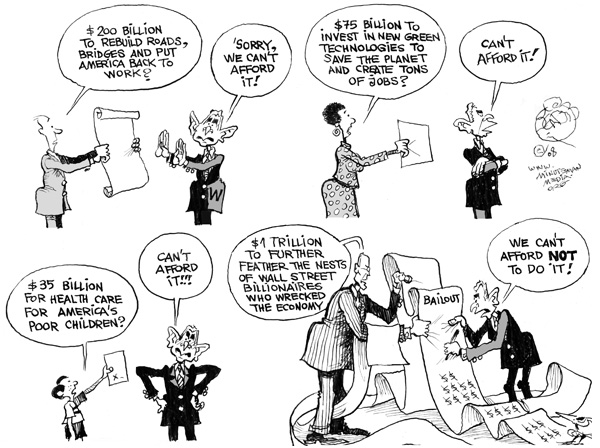

Cartoon du Jour - By Khalil
If the cartoon doesn't load automatically, please visit the following URL to manually load the cartoon:http://www.bendib.com/newones/2008/october/small/10-2-Can
Wicked cartoons by America's Most Wanted Political Cartoonist. Enjoy!
Check-out-the-cartoon-book
(Received in email. Thanks Max!)
Mud disaster follows hurricanes in Gonaives, Haiti
 Early photo of Gonaives after storm (not connected to this article but gives good idea of extent of mud that flowed into Gonaives and apparently is still there)
Source: Catholic Relief Services (CRS)
Date: 14 Oct 2008
Date: 14 Oct 2008
Mud disaster follows hurricanes in Gonaives, Haiti
Donal Reilly is CRS senior emergency advisor in Haiti where he worked from 1996 to 2002. He returned to the country in September.
Gonaives is a mess. Haiti is a hard-pressed country on a good day. I used to work in the slums in Port-au-Prince, but I've never seen this amount of destruction. The water was a huge problem at first. It rose past the first floor levels of the buildings at the center of town. People who worked in Ache described it like the Tsunami effect, but the water didn't come from the sea.
Now with the water receding, the silt is settling and the mud is becoming more of a problem. I've never seen a place so choked by debris. The UN has calculated 2.5 million cubic meters of mud have been deposited in the city alone. I estimate it would take removing about 400 truckloads of mud a day, every day for a year to clear Gonaives
With all the mud on the streets there is no drainage. The drains are full. The septic tanks are full. The pit latrines are full. Gonaives is basically a city without sanitation.
People are already cleaning the mud out of their homes and business, but the problem is, there is nowhere to dump the mud. So they put it in the streets and it piles up and hinders mobility. If it rains again before the streets are cleared their houses will effectively be turned into swimming pools. This is because their buildings are at a lower level than the streets around them. Since there is no drainage, the water just stays there.
Haiti: Survivors in Flooded Village Stranded with No Help
 The area of Mamont, in the Artibonite region, remains partially submerged under water.
 INCLUDES Reuters Video: Submerged Village in Haiti
Haiti: Survivors in Flooded Village Stranded with No Help
One month after storms, needs remain huge; people being forced from shelters
Port-au-Prince/New York, October 3, 2008 — A month after the last tropical storms and hurricanes hit Haiti, Doctors Without Borders/Médecins Sans Frontières (MSF) medical teams have found a whole village partially submerged and its 2,400 remaining inhabitants stranded with no help.
READ REST OF STORY BY CLICKING http://www.doctorswithoutborders.org/pr/release.cfm?id=3135
DOCTORS WITHOUT BORDERS Press Release
October 2, 2008
October 2, 2008
Haiti: Survivors in Flooded Village Stranded with No Help
One month after storms, needs remain huge; people being forced from shelters
Port-au-Prince/New York, October 3, 2008 — A month after the last tropical storms and hurricanes hit Haiti, Doctors Without Borders/Médecins Sans Frontières (MSF) medical teams have found a whole village partially submerged and its 2,400 remaining inhabitants stranded with no help.
READ REST OF STORY BY CLICKING http://www.doctorswithoutborders.org/pr/release.cfm?id=3135
Monday, October 6, 2008
HPSP Annual Benefit for Haiti in Woodstock, New York

THE HAITIAN PEOPLE'S SUPPORT PROJECT
WOODSTOCK, NEW YORK
(I attended this group's first annual benefit in 1990 in Woodstock and they are still going strong today with various projects throughout Haiti and for Haitians in the Dominican Republic. The art and crafts are directly from Haiti, the dancing fun and the restaurant is one of the best in the Woodstock area!)
Soñando! Sounding Out the Latin Beat!
10th Annual Benefit Dance for the children of Haiti
Haitian Art and Craft Sale
Date: Friday, November 14, 2008
Time: 9pm-1am...
Craft Sale @ 7:30 PM
Place: New World Home Cooking Rte. 212
(between Saugerties & Woodstock)
Suggested Donation: $20
For More Information Call: 679-7320 or 246-0900
Or Contact Pierre Leroy – pierre_leroy2003@yahoo.com
Haïti, sur le passage des ouragans
Haiti, the passage of the storms, September 28, 2008
Graphic 8 minute news video by France 24 and Le magazine de l'action humanitaire
Par FRANCE 24 (texte) / Nicolas Ransom et Mary McCarthy (vidéo
http://www.france24.com/fr/20080928-humanitaire-haiti-cyclone-catastrophe-naturelle-gonaives
Graphic 8 minute news video by France 24 and Le magazine de l'action humanitaire
Par FRANCE 24 (texte) / Nicolas Ransom et Mary McCarthy (vidéo
http://www.france24.com/fr/20080928-humanitaire-haiti-cyclone-catastrophe-naturelle-gonaives
Death of Detained Immigrant Inspires Online Game With Goal of Educating Players
 ( Photo borrowed from http://www.nytimes.com/2008/05/05/nyregion/05detain.html,
 Few Details on Immigrants Who Died in Custody by Nina Bernstein, May 5, 2008)
Death of Detained Immigrant Inspires Online Game With Goal of Educating Players
by Nina Bernstein
The New York Times, October 5, 2008
The death last year of Boubacar Bah, a Guinean tailor held in a New Jersey jail for overstaying his visa, showed immigration detention to be one of the most secretive corners of American life. But now Mr. Bah’s story is being retold in an unusually public way: in an online video game.
The game at (http://www.homelandgitmo.com/)— created by Breakthrough, an international human rights organization in New York that is trying to get the public behind efforts to strengthen oversight, due process and medical help in immigration detention — uses Mr. Bah’s story to walk players through a simulated detention center, and into the documented ordeals of other detainees. They include a pregnant woman kept in shackles during labor and an Army veteran held for three years while he fought deportation.
The video game (which can be found at http://www.homelandgitmo.com/) casts the player as a reporter seeking clues in the death of Mr. Bah, 52, who suffered a skull fracture and brain hemorrhages in the Elizabeth Detention Center in New Jersey. A cartoon guide leads the way to actual video testimonials of former detainees and information that unlocks the mystery of Mr. Bah’s fate.
CLICK ON http://www.nytimes.com/2008/10/05/nyregion/05detain.html?_r=1&oref=slogin to read rest of article.
Friday, September 26, 2008
Haiti is in ruins by Marleine Bastien

CARIBBEAN CROSSROADS: Haiti is in ruins
BY Marleine Bastien, South Florida Times, September 26, 2008
Tande se Youn- We se de.
That’s Creole for the saying, “Hearing it is one thing, seeing it is another.’’
I arrived in Haiti last Friday with a big delegation of city officials, Miami City Commissioner Michelle Spence-Jones, North Miami City Councilman Jacques Despinosse, state Rep. Yolly Roberson, community activists and city employees with a sense of purpose.
First step: Cite Soleil. Within a New York minute, we were surrounded by an army of men, children and women, including pregnant women.
Marie wanted us to see her still inundated one-room house. Her earthly possessions were meager. A makeshift bed supported by four blocks and flattened carton boxes served as a mattress. She had a few rags. The family’s only clothes were the bedcovers.
In the middle of the bed lay a very small, 6-day-old baby. She was born at term, but she looked so tiny. She could have been mistaken for a doll. Her name is Denise. She cried a very weak, barely audible cry. She had not had anything to eat all day. It was 4 o’clock. Her mother was so malnourished that her breast milk had dried up.
Read rest of article at http://www.sfltimes.com/index.php?option=com_content&task=view&id=1960&Itemid=188
Thursday, September 25, 2008
HAITI Road Conditions Map, 24 Sep 08
Weeks after four storms hit Haiti, it is still plagued by collapsed bridges, potential mudslides, flooding, etc.
See map for updated details. http://www.logcluster.org/ht08a/road-transport/road-condition-map/ Click on pdf file to open large, elaborate full-color map.
"This map needs your help! If you have updated information, contact 509 3701 2355 or bernard.wright@wfp.org "
See map for updated details. http://www.logcluster.org/ht08a/road-transport/road-condition-map/ Click on pdf file to open large, elaborate full-color map.
"This map needs your help! If you have updated information, contact 509 3701 2355 or bernard.wright@wfp.org "
Wednesday, September 24, 2008
Haiti, still over the brink by Edwidge Danticat
 Dog circles mud cakes for sale (photo accompanying Danticat article in Philadelphia Inquirer online)
 Gonaives, and much of the country, under mud. Loss of lives, livestock, homes, infrastructure, four key bridges, crops that were ready for harvest.... (photo not part of original article)
 Haiti Still Over the Brink
Hurricane's devastation requires the world's attention.
Philadelphia Inquirer, September 24, 2008
Philadelphia Inquirer, September 24, 2008
Edwidge Danticat is a Haitian-American writer living in Miami
Haiti desperately needs your help.
While most Americans have understandably been concerned about Hurricane Ike's assault on Texas, people in Haiti just a few hundred miles away are suffering an even worse fate.
Haiti desperately needs your help.
While most Americans have understandably been concerned about Hurricane Ike's assault on Texas, people in Haiti just a few hundred miles away are suffering an even worse fate.
More than a week after Ike assaulted Haiti, people in Gonaives, the country's third-largest city, were still stranded on rooftops and trapped by rivers of mud. Others in remote areas remained huddled in schools and churches, cut off from the capital by washed-out bridges and roads.
At least 1,000 deaths have been reported. A million people remained homeless. Crops and livestock had been wiped out, making a chronically dire hunger situation worse.
Haiti is not just on the brink of disaster, as Haitian President Rene Preval noted in his plea for international aid. It's over the brink.
Right now, Haiti needs all the help it can get, with food, drinking water, medical supplies and shelter at the top of the list.
Haiti's neighbors and the international community must not only find the will and compassion to help the country's desperate survivors, but they also need to ensure a steady supply of aid down the road. Haiti's problems did not recede with the floodwaters, and the international community must recognize this.
For its part, the Haitian government, which had begun to invest heavily in agriculture in the devastated regions, needs to continue to pursue long-term solutions, including large-scale reforestation and alternative fuels to replace the charcoal production that has left Haiti with less than 2 percent tree cover.
It is also vital that Haitians living and working in the United States not be deported back to Haiti at this devastating time. Deportations threaten the most consistent type of aid that Haitians receive. It comes in the form of $2 billion in remittances from friends and relatives abroad.
The U.S. government may fear that granting Haitians temporary protection status will encourage mass migration to U.S. shores. However, it is mass starvation and political instability that have encouraged Haitian sea migration more than anything else.
Haitians are strong and proud and determined, and most will survive this latest in a string of political and natural disasters. But at this most vulnerable time, they need your help to overcome the immediate crisis and implement long-term solutions.
Want to help? Please check out these two organizations:
Partners In Health (pih.org), founded by Paul Farmer, provides medical care to the poor and is participating in relief efforts.
The Lambi Fund of Haiti (lambifund.org) supports sustainable development by channeling resources to community-based institutions.
E-mail Edwidge Danticat at pmproj@progressive.org.
Haiti Needs Our Help
 Appeal from New York City Council Speaker, Christine C. Quinn:
Dear New Yorkers,
I am writing today in hopes that you might join me in spreading the word about efforts currently underway to provide badly-needed relief to hurricane victims in Haiti.
As you know, this past month, three deadly hurricanes left more than 100 dead and tens of thousands homeless in Haiti before barreling into the U.S. and wreaking havoc and destruction along the Gulf Coast.
On Thursday, following similar relief efforts to our neighbors in the South, Governor Paterson directed the opening of the New York Army National Guard Armory in Brooklyn to allow for the collection of donated relief supplies for the hurricane-stricken island nation of Haiti.
Items in high demand for shipment to Haiti include:
Bottled water (packed in cases or six packs at a minimum). Single bottles are inappropriate donations since they would have to be repackaged.
Rice (dried in bags)
Beans (dried cans only)
Sterno canisters
Tarpaulin (of any size, preferably 10 ft. x 10 ft. or larger) - to be used for both roofing and flooring
Nylon cord (100 ft. rolls)
Hygiene items limited to toothbrushes, toothpaste, mild soaps
New underclothes (children sizes)
New hand towels
Soldiers from the New York National Guard will be on hand to receive, sort and prepare donations at the following locations:
Bedford Armory1579 Bedford Avenue at Union Street, BrooklynSept. 18 - Sept. 26, 8 a.m. to 5 p.m.
Adam Clayton Powell State Office Building163 West 125th at Adam Clayton Powell Jr. Blvd., HarlemSept. 18 - Sept. 26, 8 a.m. to 5 p.m.
As the aftermath of these hurricanes continues to unfold, it’s important that we do what we can to help alleviate some of the pain and suffering in Haiti.
The Council and I have already begun reaching out to our constituents to encourage them to collect and donate. If you could please pass this information along to the members of your community and encourage them to do the same, we’d deeply appreciate it. Working together, we can help make a difference in the lives of the Haitian people.
In closing, I would like to thank all of our state and city elected officials, especially Governor Paterson, Council Members Mathieu Eugene and Larry Seabrook, and the members of the Council’s Black, Latino and Asian Caucus, for heading up this important relief effort.
I would also like to thank our brave men and women of the New York National Guard for once again stepping in during a time of crisis to help those in need.
For more information about the Haitian relief effort, please call (212)681-4010 or e-mail relief@chamber.state.ny.us.
Best wishes.
Sincerely,
Christine C. Quinn
Speaker, New York City Council
Tuesday, September 23, 2008
Donors ignore UN Haiti storm appeal
Donors ignore UN Haiti storm appeal
Reuters AlertNet, 23 Sep 2008
Written by: Emma Batha
U.N. agencies are pressing donors to cough up cash for storm-battered Haiti after receiving only a tiny fraction of the funds needed to help hundreds of thousands of survivors living on the edge.
The $108 million flash appeal launched almost a fortnight ago has attracted just $3.7 million, according to the U.N. relief co-ordination office known as OCHA.
"It's 3.4 percent covered. That's very, very low. I don't know what people are waiting for. I have no clue," said OCHA spokeswoman Stephanie Bunker.
"Given the scale of the disaster and the relative visibility of it in the news media, one is surprised. It was not a disaster that was here one day and gone the next."
Four storms - Fay, Gustav, Hanna and Ike - have hammered Haiti since mid August, killing 600 people and leaving 800,000 in dire need of help after destroying houses, infrastructure and crops.
Bunker said she was puzzled that no one had donated money towards the United Nations' food operations, an area that normally attracts relatively generous funds in emergency appeals.
"It's especially surprising given what we all know about the food situation in Haiti and how much, even before the hurricane, people were being squeezed by high food prices," she added.
More than half Haiti's population subsists on $1 a day. Anger over rising food and fuel prices triggered deadly riots earlier this year, bringing down the government.
Bunker said donors had also failed to give money to other crucial sectors in the U.N. appeal, including water and sanitation, agriculture, economic recovery and education.
Although they have pledged another $18 million for Haiti, they have not yet turned these promises into cash.
By contrast, the U.N. appeal after the cyclone that hit Myanmar in May is 52 percent funded and the food requests are 83 percent covered. The more recent U.N. appeal for Georgia is 42 percent covered.
CROPS WIPED OUT
The World Food Programme, the U.N. food agency, said its operation in Haiti was proving very difficult because of the colossal destruction to infrastructure, which means most aid can only be brought in by air or sea.
"We would urge donors who have promised money to get it in our coffers as soon as possible so we can keep our pipelines flowing," said WFP spokeswoman Hilary Clarke.
"Our biggest concern is that an estimated 70 percent of Haiti's agriculture has been destroyed, which is indeed extremely serious," she added.
"The hurricane has come at a very bad time because crops like rice and maize were seedlings and it has washed them all away. And cash crop trees like mango and banana trees have suffered terrible devastation."
Clarke said another major worry was that many people who had lost their homes needed to buy basic household items, reducing the amount they could spend on food.
WFP has so far delivered 1,470 metric tonnes of food to more than 313,000 people. By the end of the week, it will have the use of four boats and two helicopters. Another two helicopters and 20 off-road trucks are on their way.
Outside the U.N. flash appeal, OCHA said donors had given some $17 million in bilateral aid to Haiti and promised another $6 million.
Reuters AlertNet
Reuters AlertNet, 23 Sep 2008
Written by: Emma Batha
U.N. agencies are pressing donors to cough up cash for storm-battered Haiti after receiving only a tiny fraction of the funds needed to help hundreds of thousands of survivors living on the edge.
The $108 million flash appeal launched almost a fortnight ago has attracted just $3.7 million, according to the U.N. relief co-ordination office known as OCHA.
"It's 3.4 percent covered. That's very, very low. I don't know what people are waiting for. I have no clue," said OCHA spokeswoman Stephanie Bunker.
"Given the scale of the disaster and the relative visibility of it in the news media, one is surprised. It was not a disaster that was here one day and gone the next."
Four storms - Fay, Gustav, Hanna and Ike - have hammered Haiti since mid August, killing 600 people and leaving 800,000 in dire need of help after destroying houses, infrastructure and crops.
Bunker said she was puzzled that no one had donated money towards the United Nations' food operations, an area that normally attracts relatively generous funds in emergency appeals.
"It's especially surprising given what we all know about the food situation in Haiti and how much, even before the hurricane, people were being squeezed by high food prices," she added.
More than half Haiti's population subsists on $1 a day. Anger over rising food and fuel prices triggered deadly riots earlier this year, bringing down the government.
Bunker said donors had also failed to give money to other crucial sectors in the U.N. appeal, including water and sanitation, agriculture, economic recovery and education.
Although they have pledged another $18 million for Haiti, they have not yet turned these promises into cash.
By contrast, the U.N. appeal after the cyclone that hit Myanmar in May is 52 percent funded and the food requests are 83 percent covered. The more recent U.N. appeal for Georgia is 42 percent covered.
CROPS WIPED OUT
The World Food Programme, the U.N. food agency, said its operation in Haiti was proving very difficult because of the colossal destruction to infrastructure, which means most aid can only be brought in by air or sea.
"We would urge donors who have promised money to get it in our coffers as soon as possible so we can keep our pipelines flowing," said WFP spokeswoman Hilary Clarke.
"Our biggest concern is that an estimated 70 percent of Haiti's agriculture has been destroyed, which is indeed extremely serious," she added.
"The hurricane has come at a very bad time because crops like rice and maize were seedlings and it has washed them all away. And cash crop trees like mango and banana trees have suffered terrible devastation."
Clarke said another major worry was that many people who had lost their homes needed to buy basic household items, reducing the amount they could spend on food.
WFP has so far delivered 1,470 metric tonnes of food to more than 313,000 people. By the end of the week, it will have the use of four boats and two helicopters. Another two helicopters and 20 off-road trucks are on their way.
Outside the U.N. flash appeal, OCHA said donors had given some $17 million in bilateral aid to Haiti and promised another $6 million.
Reuters AlertNet
Monday, September 22, 2008
Changes in U.S. policies would calm Haiti's storm
Indystar.com
September 22, 2008
Changes in U.S. policies would calm Haiti's storm
Fran Quigley
Vicious storms transformed the streets of Gonaives, Haiti, into mud-choked, fetid rivers. Rotting animal carcasses floated between homes where people had scrambled to the rooftops, clutching their belongings and praying for the waters to recede. Thousands more people were forced to the roads, carrying goats and children as they searched for shelter, food and water. Death toll estimates climbed to more than 1,000.
This was Haiti earlier this month. But it was also Haiti in 2004, when Tropical Storm Jeanne killed 3,000 people. And it will be Haiti again -- maybe next week, maybe next year, but assuredly soon -- unless the United States changes our policies that hurt the people of our hemisphere's poorest nation.
In Haiti, the deadly consequences of tropical storms and hurricanes are more of a political tragedy than a meteorological one. Other Caribbean nations, including Cuba, were battered by the storms but suffered only a handful of casualties. As Partners in Health's Dr. Paul Farmer wrote from submerged Gonaives two weeks ago, Haiti is suffering from a distinctly un-natural disaster.
"The real storm damage doesn't come from the ocean waves," says Brian Concannon of the Institute for Justice and Democracy in Haiti. "It comes from the water pouring down from the mountains stripped bare of any trees and into communities with horribly inadequate drainage systems. Many poor Haitians have little alternative but to cut down trees to sell for charcoal, and the government of Haiti doesn't have the ability to install a decent drainage system or coordinate disaster response."
Concannon and other advocates for Haiti, including thousands of Hoosiers who are active in the 68 Indiana Roman Catholic parishes that have relationships with Haitian counterparts, identify several solutions the United States can kick-start immediately.
First, the Senate can pass the Jubilee Act, which would cancel the debt of impoverished countries like Haiti. "Haiti is sending $1 million each week to banks to pay off debt when that money could be much better spent on reforestation or disaster planning," Concannon says. The House version of the Jubilee Act passed in April, while the Senate version, co-sponsored by Sen. Richard Lugar, awaits a vote.
Sen. Evan Bayh should follow Lugar's lead, and Congress should pass the Jubilee Act this fall. Forcing Haitians victimized by oppressive regimes to repay the debts incurred by their past dictators is like forcing a battered wife to repay the pawn shop for the cost of the knife used to attack her.
Second, President Bush can grant temporary protected status to Haitians currently living in the United States, which would allow those non-residents to work without fear of deportation and send money back to suffering families. Haiti's economy is so weak that these remittances already equal an estimated 25 percent of the country's gross domestic product. Granting short-term lenience for immigrants from similarly struggling countries like El Salvador, Somalia and Sudan has helped provide the kind of short-term relief Haiti needs now.
Third, we can reform U.S. trade policy that has crippled Haiti's agricultural economy. The recent global spike in food costs leaves many Haitians so desperate that they are forced to literally eat dirt. That shouldn't happen in Haiti, which as recently as the 1980s produced all the rice needed to feed the country. Now, subsidized U.S. imports have forced Haitian farmers out of the market. "I know Haitian rice farmers who got so little return on their crops they couldn't afford to pay for help to harvest it," Concannon says. "So they left the rice unharvested in the fields."
Unless we change U.S. policies immediately, it is the country of Haiti that is being left in the water to rot.
Quigley is an attorney and director of operations for the Indiana-Kenya Partnership. Quigley is an attorney and director of operations for the Indiana-Kenya Partnership.
September 22, 2008
Changes in U.S. policies would calm Haiti's storm
Fran Quigley
Vicious storms transformed the streets of Gonaives, Haiti, into mud-choked, fetid rivers. Rotting animal carcasses floated between homes where people had scrambled to the rooftops, clutching their belongings and praying for the waters to recede. Thousands more people were forced to the roads, carrying goats and children as they searched for shelter, food and water. Death toll estimates climbed to more than 1,000.
This was Haiti earlier this month. But it was also Haiti in 2004, when Tropical Storm Jeanne killed 3,000 people. And it will be Haiti again -- maybe next week, maybe next year, but assuredly soon -- unless the United States changes our policies that hurt the people of our hemisphere's poorest nation.
In Haiti, the deadly consequences of tropical storms and hurricanes are more of a political tragedy than a meteorological one. Other Caribbean nations, including Cuba, were battered by the storms but suffered only a handful of casualties. As Partners in Health's Dr. Paul Farmer wrote from submerged Gonaives two weeks ago, Haiti is suffering from a distinctly un-natural disaster.
"The real storm damage doesn't come from the ocean waves," says Brian Concannon of the Institute for Justice and Democracy in Haiti. "It comes from the water pouring down from the mountains stripped bare of any trees and into communities with horribly inadequate drainage systems. Many poor Haitians have little alternative but to cut down trees to sell for charcoal, and the government of Haiti doesn't have the ability to install a decent drainage system or coordinate disaster response."
Concannon and other advocates for Haiti, including thousands of Hoosiers who are active in the 68 Indiana Roman Catholic parishes that have relationships with Haitian counterparts, identify several solutions the United States can kick-start immediately.
First, the Senate can pass the Jubilee Act, which would cancel the debt of impoverished countries like Haiti. "Haiti is sending $1 million each week to banks to pay off debt when that money could be much better spent on reforestation or disaster planning," Concannon says. The House version of the Jubilee Act passed in April, while the Senate version, co-sponsored by Sen. Richard Lugar, awaits a vote.
Sen. Evan Bayh should follow Lugar's lead, and Congress should pass the Jubilee Act this fall. Forcing Haitians victimized by oppressive regimes to repay the debts incurred by their past dictators is like forcing a battered wife to repay the pawn shop for the cost of the knife used to attack her.
Second, President Bush can grant temporary protected status to Haitians currently living in the United States, which would allow those non-residents to work without fear of deportation and send money back to suffering families. Haiti's economy is so weak that these remittances already equal an estimated 25 percent of the country's gross domestic product. Granting short-term lenience for immigrants from similarly struggling countries like El Salvador, Somalia and Sudan has helped provide the kind of short-term relief Haiti needs now.
Third, we can reform U.S. trade policy that has crippled Haiti's agricultural economy. The recent global spike in food costs leaves many Haitians so desperate that they are forced to literally eat dirt. That shouldn't happen in Haiti, which as recently as the 1980s produced all the rice needed to feed the country. Now, subsidized U.S. imports have forced Haitian farmers out of the market. "I know Haitian rice farmers who got so little return on their crops they couldn't afford to pay for help to harvest it," Concannon says. "So they left the rice unharvested in the fields."
Unless we change U.S. policies immediately, it is the country of Haiti that is being left in the water to rot.
Quigley is an attorney and director of operations for the Indiana-Kenya Partnership. Quigley is an attorney and director of operations for the Indiana-Kenya Partnership.
Sunday, September 21, 2008
La Troupe Makandal upcoming events: The Color of All Shadows: A Tribute to Makandal

Friday, October 10, 2008, 4 pm (roundtable) and 7 pm (performance)
The Color of All Shadows: A Tribute to Makandal
Please join Makandal in a celebration of the life and the magical passing of our company's namesake.
Precisely two hundred and fifty years ago French colonists arrested the maroon Makandal in northern St. Domingue for his plot to liberate the island. Mystery surrounds the story of his execution, which, according to many, never happened. Our program begins with a roundtable discussion with scholars and audience, who will attempt to sort out legend and fact and explore the reasons for Makandal's relative obscurity in the pantheon of s/heroes.
The Troupe will follow with a performance bringing together music, song, dance, literature, and visual arts.
Presentors and performers include Dr. Patrick Bellegarde-Smith, University of Wisconsin at Milwaukee; Marie Lily Cerat, Haitian Bilingual Technical Assistance Center at Brooklyn College; Dr. Frantz-Antoine Leconte, Kingsborough Community College; Dr. Lois Wilcken, La Troupe Makandal/City Lore; Frisner Augustin and La Troupe Makandal; Graphics by Kesler Pierre; and Edgar NKosi White.
Roundtable: FREE.
Performance: $10, FREE for students with Hunter College ID.
The Color of All Shadows has received support in part from the Puffin Foundation, the New York Council for the Humanities, and the National Endowment for the Humanities.
Location:Ida K. Lang Recital Hall, Room 424 Hunter College North. Take the 6 subway to 68 Street/Hunter College. Use the entrance on East 69 Street between Park And Lexington Avenues. Take the elevator to the fourth floor and make a left toward the Lang Recital Hall.
See photo, hear music and learn more at http://www.makandal.org/
Friday, September 19, 2008
Haiti and the Jean Dominique Investigation: An Interview with Mario Joseph and Brian Concannon
 Jean Dominique and wife Michele Montas (r) at birthday event for Jean-Bertrand Aristide at Aristide's home, July 15, 1995, Photo by Michelle Karshan (not part of the published article) (Copyright)
The Journal of Haitian Studies, Vol. 13 No. 2 © 2007
Jeb Sprague, University of Manchester
Haiti and the Jean Dominique Investigation: An Interview with Mario Joseph and Brian Concannon
On April 3, 2000, Jean Dominique, Haiti’s most popular journalist, was shot four times in the chest as he arrived for work at Radio Haïti. The station’s security guard Jean-Claude Louissant was also killed in the attack. The President of Haiti, René Préval, ordered three days of official mourning and 16,000 people reportedly attended his funeral. A documentary film released in 2003, The Agronomist, by Academy Award-winning director Jonathan Demme featured Dominique’s inspiring life. However, since Dominique’s death the investigation into his murder has sparked a constant point of controversy. Attorneys Mario Joseph and Brian Concannon worked for the Bureau des Avocats Internationaux (BAI), a human rights lawyer’s office supported by both the Préval and Aristide governments. The BAI was tasked with helping to investigate the killings. A discussion with the two attorneys reveals the unpublished perspective of former government insiders who worked on the case and their thoughts on the role of former Senator Dany Toussaint, the investigation headed by Judge Claudy Gassant, the mobilization around the case, and recent revelations made by Guy Philippe, a leader of the ex-military organization Front pour la Libération et la Réconstruction Nationales (FLRN). This interview was conducted over the telephone and by e-mail during April and May of 2007.
JS: It has been seven years since Jean Dominique was killed. From your perspective, how did the investigation into the killing of Jean Dominique begin?
BC: The investigation started immediately. Police came to the scene a few minutes after the killing. There were lots of false starts, because the system, although functional, was not up to a case this tough, but there was a continuous effort to investigate.
MJ: After Dominique was killed there was a huge public funeral at a sports stadium in Port-au-Prince. Both the current President Préval and the former President Aristide participated in the funeral. Both were visibly upset. First under the Préval, and later the second Aristide administrations, our legal group the Bureau des Avocats Internationaux (BAI) was tasked with following up on the case. We were initially asked by Michèle Montas, Jean Dominique’s widow, who asked me to represent her as a civil lawyer, as I was doing for the victims of the Raboteau massacre. But we were also asked to work on the case by both Presidents. Soon after Aristide was elected, and from time to time during his administration (2001-2004) we talked with him about the Jean Dominique case. We asked him, as he was the executive, what he wanted us to do on the case? He answered, “Find the murderers.”
JS: Who were the initial suspects and how did the investigation evolve?
BC: There were lots of leads at the beginning. There were leads pointing to Dany Toussaint but also several other people, including several members of what became the Group of 184.2 Some of the leads were based on witness reports. Some were based on tips—we set up a hotline in our office for tips, and the number was broadcast on Radio Haiti. Other leads were based on
circumstantial evidence.
MJ: We did not see all the evidence—under Haitian tradition the judge’s pre-trial investigation is secret—and we never saw direct evidence of Mr. Toussaint’s involvement in the crime. But there was circumstantial evidence, and our position was always that all the leads should be followed against everyone, including Dany Toussaint. Presidents Préval and Aristide both told us the same thing—pursue the case and the leads. Judge Claudy Gassant was named investigating judge on the case, I believe sometime in mid-2000, and headed up the investigation. But we felt already in 2000 that many people were using the investigation as a political tool for undermining the Lavalas movement (Aristide did not take office until 2001). The pressures from the international community and elite Haitian civil society were to pursue people based on their connection with Fanmi Lavalas rather than based on the available evidence. We were not involved in any discussions of whether or not Dany Toussaint was guilty. We did not then and still do not have enough information to take a position on that. Our interest was in the process—were all the leads, no matter where they led, being followed? Was Haitian law, and the rights of the victims, and of the accused, respected? We felt there certainly was good reason to support investigating Mr. Toussaint, and we supported that investigation. But we were also concerned that promising leads involving other targets were being neglected.
Jeb Sprague, University of Manchester
Haiti and the Jean Dominique Investigation: An Interview with Mario Joseph and Brian Concannon
On April 3, 2000, Jean Dominique, Haiti’s most popular journalist, was shot four times in the chest as he arrived for work at Radio Haïti. The station’s security guard Jean-Claude Louissant was also killed in the attack. The President of Haiti, René Préval, ordered three days of official mourning and 16,000 people reportedly attended his funeral. A documentary film released in 2003, The Agronomist, by Academy Award-winning director Jonathan Demme featured Dominique’s inspiring life. However, since Dominique’s death the investigation into his murder has sparked a constant point of controversy. Attorneys Mario Joseph and Brian Concannon worked for the Bureau des Avocats Internationaux (BAI), a human rights lawyer’s office supported by both the Préval and Aristide governments. The BAI was tasked with helping to investigate the killings. A discussion with the two attorneys reveals the unpublished perspective of former government insiders who worked on the case and their thoughts on the role of former Senator Dany Toussaint, the investigation headed by Judge Claudy Gassant, the mobilization around the case, and recent revelations made by Guy Philippe, a leader of the ex-military organization Front pour la Libération et la Réconstruction Nationales (FLRN). This interview was conducted over the telephone and by e-mail during April and May of 2007.
JS: It has been seven years since Jean Dominique was killed. From your perspective, how did the investigation into the killing of Jean Dominique begin?
BC: The investigation started immediately. Police came to the scene a few minutes after the killing. There were lots of false starts, because the system, although functional, was not up to a case this tough, but there was a continuous effort to investigate.
MJ: After Dominique was killed there was a huge public funeral at a sports stadium in Port-au-Prince. Both the current President Préval and the former President Aristide participated in the funeral. Both were visibly upset. First under the Préval, and later the second Aristide administrations, our legal group the Bureau des Avocats Internationaux (BAI) was tasked with following up on the case. We were initially asked by Michèle Montas, Jean Dominique’s widow, who asked me to represent her as a civil lawyer, as I was doing for the victims of the Raboteau massacre. But we were also asked to work on the case by both Presidents. Soon after Aristide was elected, and from time to time during his administration (2001-2004) we talked with him about the Jean Dominique case. We asked him, as he was the executive, what he wanted us to do on the case? He answered, “Find the murderers.”
JS: Who were the initial suspects and how did the investigation evolve?
BC: There were lots of leads at the beginning. There were leads pointing to Dany Toussaint but also several other people, including several members of what became the Group of 184.2 Some of the leads were based on witness reports. Some were based on tips—we set up a hotline in our office for tips, and the number was broadcast on Radio Haiti. Other leads were based on
circumstantial evidence.
MJ: We did not see all the evidence—under Haitian tradition the judge’s pre-trial investigation is secret—and we never saw direct evidence of Mr. Toussaint’s involvement in the crime. But there was circumstantial evidence, and our position was always that all the leads should be followed against everyone, including Dany Toussaint. Presidents Préval and Aristide both told us the same thing—pursue the case and the leads. Judge Claudy Gassant was named investigating judge on the case, I believe sometime in mid-2000, and headed up the investigation. But we felt already in 2000 that many people were using the investigation as a political tool for undermining the Lavalas movement (Aristide did not take office until 2001). The pressures from the international community and elite Haitian civil society were to pursue people based on their connection with Fanmi Lavalas rather than based on the available evidence. We were not involved in any discussions of whether or not Dany Toussaint was guilty. We did not then and still do not have enough information to take a position on that. Our interest was in the process—were all the leads, no matter where they led, being followed? Was Haitian law, and the rights of the victims, and of the accused, respected? We felt there certainly was good reason to support investigating Mr. Toussaint, and we supported that investigation. But we were also concerned that promising leads involving other targets were being neglected.
TO READ ENTIRE INTERVIEW CLICK LINK BELOW:
Friday, September 12, 2008
Constant Sorrow
By Bernice Yeung
Mother Jones, May/June 2008 Issue
Commentary: It wasn't Toto Constant's human rights violations that finally landed the Haitian paramilitary leader in prison. It was mortgage fraud in Long Island.
on a weekday morning last August, I sat in the visiting room of the Coxsackie Correctional Facility in upstate New York gazing at the elaborate concertina wire that surrounds it. After a long wait, a metal gate clanged shut and in walked Emmanuel Constant, founder and former leader of the Front for the Advancement and Progress of Haiti (fraph), an organization linked to the rapes and murders of pro-democracy activists in Haiti during the early 1990s. He smiled pleasantly and extended his hand for a firm shake.
I'd seen footage of Constant back in his heyday sporting tailored suits before a throng of microphones and firing up rallies with a raised fist. Now he appeared somber in state-issued forest-green slacks and a yellow polo shirt. He had the same long, equine face and pronounced jowls, but at 51, his short Afro was flecked with gray and he wore drugstore-style glasses. Working the media is perhaps Constant's greatest skill—he is personable, charming, even likable. But he wasn't ready to trust a surprise visitor, he said, so we made small talk, chatting about the public-speaking and memoir-writing classes he'd taken prior to lockup and about his jailhouse reading of John Grisham and self-help books.
Continues at http://motherjones.com/commentary/columns/2008/05/witness-constant-sorrow.html
Mother Jones, May/June 2008 Issue
Commentary: It wasn't Toto Constant's human rights violations that finally landed the Haitian paramilitary leader in prison. It was mortgage fraud in Long Island.
on a weekday morning last August, I sat in the visiting room of the Coxsackie Correctional Facility in upstate New York gazing at the elaborate concertina wire that surrounds it. After a long wait, a metal gate clanged shut and in walked Emmanuel Constant, founder and former leader of the Front for the Advancement and Progress of Haiti (fraph), an organization linked to the rapes and murders of pro-democracy activists in Haiti during the early 1990s. He smiled pleasantly and extended his hand for a firm shake.
I'd seen footage of Constant back in his heyday sporting tailored suits before a throng of microphones and firing up rallies with a raised fist. Now he appeared somber in state-issued forest-green slacks and a yellow polo shirt. He had the same long, equine face and pronounced jowls, but at 51, his short Afro was flecked with gray and he wore drugstore-style glasses. Working the media is perhaps Constant's greatest skill—he is personable, charming, even likable. But he wasn't ready to trust a surprise visitor, he said, so we made small talk, chatting about the public-speaking and memoir-writing classes he'd taken prior to lockup and about his jailhouse reading of John Grisham and self-help books.
Continues at http://motherjones.com/commentary/columns/2008/05/witness-constant-sorrow.html
"I have never seen anything as painful": Paul Farmer writes
"I have never seen anything as painful":Paul Farmer writes from flood ravaged Haiti
On Saturday, September 6, PIH co-founder Paul Farmer wrote to colleagues and supporters of Partners In Health describing the devastation caused by flooding from Hurricanes Gustav and Hanna in Haiti. The previous day Paul and colleagues from Zanmi Lasante had driven to and through the coastal city of Gonaïves, where tens of thousands of people have been driven from their homes and thousands more are living on rooftops without any access to food, water or shelter. Hurricane Ike arrived the next day with more torrential rains and deadly floods.
6 September 2008
Dear PIHers:
I am writing from Mirebalais, the place where our organization was born, having just returned from Gonaïves—perhaps the city hit hardest by Hurricane Hanna, which, hard on the heels of Fay and Gustav, drenched the deforested mountains of Haiti and led to massive flooding and mudslides in northern and central Haiti. A friend of mine said this morning: “I am 61 years old, born and raised in Hinche. I have never seen it under water.” Gonaïves, with 300,000 souls, is in far worse shape, as you’ll see from the other pictures I append. The floodwaters in Hinche are dropping, but as of 5 p.m. last night, when we left Gonaïves, the city was still under water. And hurricanes Ike and Josephine are heading this way as I write.
Twenty Questions: Social Justice Quiz 2008
Twenty Questions: Social Justice Quiz 2008
Friday 12 September 2008
by: Bill Quigley, t r u t h o u t Perspective
We in the US who say we believe in social justice must challenge ourselves to look at the world through the eyes of those who have much less than us.
Why? Social justice, as defined by John Rawls, respects basic individual liberty and economic improvement. But social justice also insists that liberty, opportunity, income, wealth and the other social bases of self-respect are to be distributed equally unless an unequal distribution is to everyone's advantage and any inequalities are arranged so they are open to all.
Therefore, we must educate ourselves and others about how liberty, opportunity, income and wealth are actually distributed in our country and in our world. Examining the following can help us realize how much we have to learn about social justice.
1. How many deaths are there worldwide each year due to acts of terrorism?
Answer: The US State Department reported there were more than 22,000 deaths from terrorism last year. Over half of those killed or injured were Muslims. Source: Voice of America, May 2, 2008. "Terrorism Deaths Rose in 2007."
2. How many deaths are there worldwide each day due to poverty and malnutrition?
A: About 25,000 people die every day of hunger or hunger-related causes, according to the United Nations. Poverty.com - Hunger and World Poverty. Every day, almost 16,000 children die from hunger-related causes - one child every five seconds. Bread for the World. Hunger Facts: International. Continues at http://www.truthout.org/article/twenty-questions-social-justice-quiz-2008
Friday 12 September 2008
by: Bill Quigley, t r u t h o u t Perspective
We in the US who say we believe in social justice must challenge ourselves to look at the world through the eyes of those who have much less than us.
Why? Social justice, as defined by John Rawls, respects basic individual liberty and economic improvement. But social justice also insists that liberty, opportunity, income, wealth and the other social bases of self-respect are to be distributed equally unless an unequal distribution is to everyone's advantage and any inequalities are arranged so they are open to all.
Therefore, we must educate ourselves and others about how liberty, opportunity, income and wealth are actually distributed in our country and in our world. Examining the following can help us realize how much we have to learn about social justice.
1. How many deaths are there worldwide each year due to acts of terrorism?
Answer: The US State Department reported there were more than 22,000 deaths from terrorism last year. Over half of those killed or injured were Muslims. Source: Voice of America, May 2, 2008. "Terrorism Deaths Rose in 2007."
2. How many deaths are there worldwide each day due to poverty and malnutrition?
A: About 25,000 people die every day of hunger or hunger-related causes, according to the United Nations. Poverty.com - Hunger and World Poverty. Every day, almost 16,000 children die from hunger-related causes - one child every five seconds. Bread for the World. Hunger Facts: International. Continues at http://www.truthout.org/article/twenty-questions-social-justice-quiz-2008
The Spin
received this in my email today:
THE SPIN:
Black teen pregnancies? A 'crisis' in black America.White teen pregnancies? A 'blessed event.'
If you grow up in Hawaii you're 'exotic.'Grow up in Alaska eating mooseburgers, you're the quintessential 'American story.'
Similarly, if you name your kid Barack you're 'unpatriotic.'Name your kids Trig and Track, you're 'colorful.'
If you're a Democrat and you make a VP pick without fully vetting the individual you're 'reckless.' A Republican who doesn't fully vet is a 'maverick.'
If you spend 3 years as a community organizer growing your organization from a staff of 1 to 13 and your budget from $70,000 to $400,000, then become the first black President of the Harvard Law Review,create a voter regstration drive that registers 150,000 new African Amerian voters, spend 12 years as a Constitutional Law professor,then spend nearly 8 more years as a State Senator representing a district with over 750,000 people, becoming chairman of the state Senate's Health and Human Services committee, then spend nearly 4 years in the United States Senate representing a state of nearly 13 million people, sponsoring 131 bills and serving on the Foreign Affairs, Environment and Public Works and Veteran's Affairs committees, you are woefully inexperienced.
If you spend 4 years on the city council and 6 years as the mayor of a town with less than 7,000 people, then spend 20 months as the governor of a state with 650,000 people, you've got the most executive experience of anyone on either ticket, are the Commander in Chief of the Alaska military and are well qualified to lead the nation should you be called upon to do so because your state is the closest state to Russia.
If you are a Demoratic male candidate who is popular with millions of people you are an 'arrogant celebrity'. If you are a popular Republican female candidate you are 'energizing the base'.
If you are a younger male candidate who thinks for himself and makes his own decisions you are 'presumptuous'. if you are an older male candidate who makes last minute decisions you refuse to explain, you are a 'shoot from the hip' maverick.
If you are a candidate with a Harvard law degree you are 'an elitist 'out of touch' with the real America. if you are a legacy (dad and granddad were admirals) graduate of Annapolis, with multiple disciplinary infractions you are a hero.
If you manage a multi-million dollar nationwide campaign, you are an 'empty suit'.If you are a part time mayor of a town of 7000 people, you are an 'experienced executive'.
If you go to a south side Chicago church, your beliefs are 'extremist'.If you believe in creationism and don't believe gobal warming is man made, you are 'strongly principled'.
If you cheated on your first wife with a rich heiress, and left your disfigured wife and married the heiress the next month, you're a Christian.
If you have been married to the same woman for 19 years with whom you are raising two beautiful daughters you're 'risky'.
If you're a black single mother of 4 who waits for 22 hours after her water breaks to seek medical attention, you're an irresponsible parent, endangering the life of your unborn child.
But if you're a white married mother who waits 22 hours, you're spunky.
If you're a 13-year-old Chelsea Clinton, the right-wing press calls you 'First dog.
'If you're a 17-year old pregnant unwed daughter of a Republican, the right-wing press calls you 'beautiful' and 'courageous.'
If you kill an endangered species, you're an excellent hunter.
If you have an abortion you're not a christian, you're a murderer ( forget about if it happened while being date raped)
If you teach abstinence only in sex education, you get teen parents.
If you teach responsible age appropriate sex education, including the proper use of birth control, you are eroding the fiber of society.
THE SPIN:
Black teen pregnancies? A 'crisis' in black America.White teen pregnancies? A 'blessed event.'
If you grow up in Hawaii you're 'exotic.'Grow up in Alaska eating mooseburgers, you're the quintessential 'American story.'
Similarly, if you name your kid Barack you're 'unpatriotic.'Name your kids Trig and Track, you're 'colorful.'
If you're a Democrat and you make a VP pick without fully vetting the individual you're 'reckless.' A Republican who doesn't fully vet is a 'maverick.'
If you spend 3 years as a community organizer growing your organization from a staff of 1 to 13 and your budget from $70,000 to $400,000, then become the first black President of the Harvard Law Review,create a voter regstration drive that registers 150,000 new African Amerian voters, spend 12 years as a Constitutional Law professor,then spend nearly 8 more years as a State Senator representing a district with over 750,000 people, becoming chairman of the state Senate's Health and Human Services committee, then spend nearly 4 years in the United States Senate representing a state of nearly 13 million people, sponsoring 131 bills and serving on the Foreign Affairs, Environment and Public Works and Veteran's Affairs committees, you are woefully inexperienced.
If you spend 4 years on the city council and 6 years as the mayor of a town with less than 7,000 people, then spend 20 months as the governor of a state with 650,000 people, you've got the most executive experience of anyone on either ticket, are the Commander in Chief of the Alaska military and are well qualified to lead the nation should you be called upon to do so because your state is the closest state to Russia.
If you are a Demoratic male candidate who is popular with millions of people you are an 'arrogant celebrity'. If you are a popular Republican female candidate you are 'energizing the base'.
If you are a younger male candidate who thinks for himself and makes his own decisions you are 'presumptuous'. if you are an older male candidate who makes last minute decisions you refuse to explain, you are a 'shoot from the hip' maverick.
If you are a candidate with a Harvard law degree you are 'an elitist 'out of touch' with the real America. if you are a legacy (dad and granddad were admirals) graduate of Annapolis, with multiple disciplinary infractions you are a hero.
If you manage a multi-million dollar nationwide campaign, you are an 'empty suit'.If you are a part time mayor of a town of 7000 people, you are an 'experienced executive'.
If you go to a south side Chicago church, your beliefs are 'extremist'.If you believe in creationism and don't believe gobal warming is man made, you are 'strongly principled'.
If you cheated on your first wife with a rich heiress, and left your disfigured wife and married the heiress the next month, you're a Christian.
If you have been married to the same woman for 19 years with whom you are raising two beautiful daughters you're 'risky'.
If you're a black single mother of 4 who waits for 22 hours after her water breaks to seek medical attention, you're an irresponsible parent, endangering the life of your unborn child.
But if you're a white married mother who waits 22 hours, you're spunky.
If you're a 13-year-old Chelsea Clinton, the right-wing press calls you 'First dog.
'If you're a 17-year old pregnant unwed daughter of a Republican, the right-wing press calls you 'beautiful' and 'courageous.'
If you kill an endangered species, you're an excellent hunter.
If you have an abortion you're not a christian, you're a murderer ( forget about if it happened while being date raped)
If you teach abstinence only in sex education, you get teen parents.
If you teach responsible age appropriate sex education, including the proper use of birth control, you are eroding the fiber of society.
Subscribe to:
Posts (Atom)